
The Decision I Avoided for Ten Years
Why capable business owners put off decisions — and how to work out which ones deserve your time and attention
Ten years ago I bought MarkElliottCoaching.com, along with the .co.uk and .me versions. Then I carried on using ArrestedArt.com for another decade.
ArrestedArt came from an art retail business I'd started. I used to call the name a badge of failure and learning, and I meant both. It gave me a story to tell about my past, and I liked telling it. I also expected that changing my website would be awkward and fiddly, so it never got near the top of the list.
The slightly embarrassing part is that I was regularly helping clients see how a clear name and brand make it easier for customers to understand what they do and buy from them. I could see it in their businesses. I didn't do it in mine.
It was Jeannie Shapiro of Think Jeannie who said it out loud. During a LinkedIn review she asked what ArrestedArt had to do with my coaching, what was the story, why had she not heard it. Why keep a website name that needed explaining when I already owned one that made sense? I didn't have a good answer, and her nudge helped me make the change.
What I noticed afterwards had little to do with the technical side. My badge of learning had been keeping me attached to the past. I can keep everything that business taught me without making it the first thing people see when they look at my work now.
Why a small decision can feel so heavy
Changing a domain is a modest decision. It takes some time and care, and it doesn't put the business at risk. Yet I avoided it for years.
I see the same thing with the owners I work with, and it has nothing to do with capability. When you're stretched, decisions with very different consequences start to feel equally demanding. Switching accounting software and rethinking your whole offer end up on the same pile, the one marked "when I've got a clear head", and that pile keeps growing.
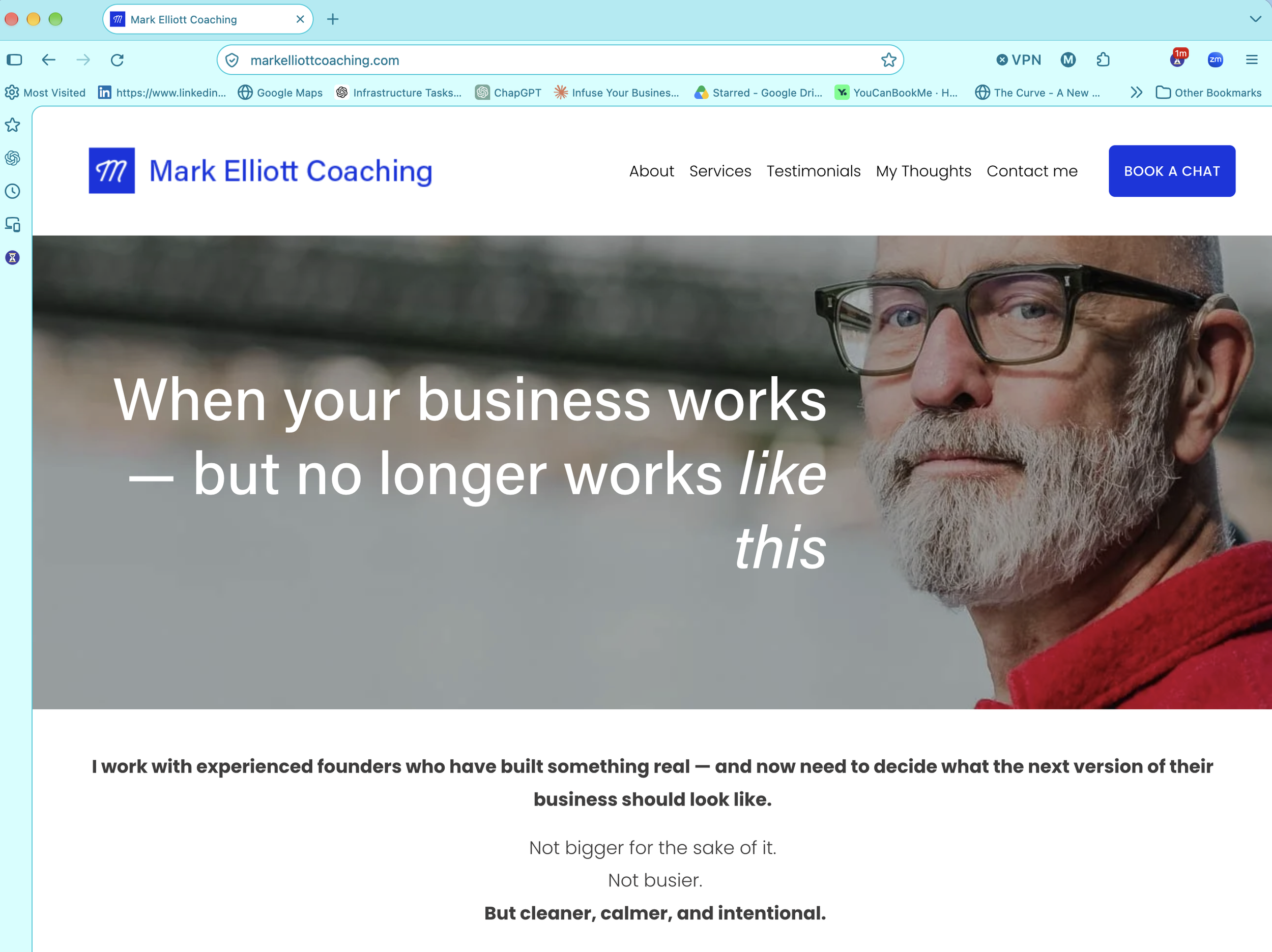
This is what my website looks like now, with consistent name, branding and with no questions about why is this site called that.
Some decisions are small in practical terms but emotionally heavy, because they're tied up with identity, loyalty, perfectionism or the stories we tell about ourselves. A name can be one of those. So can a service you've offered since the start, a long-standing customer who no longer fits, or a way of working that once felt like the whole point of going it alone.
What staying busy let me avoid
The second story is harder to tell.
For two years I ran a 25-minute reflection and focus session on Zoom every weekday morning at 8.30. It was originally an experiment. Would people find it useful? Was there a market for it? Would it fit the way I model my life and would it help me find clients?
The first participants came free. Later, others joined on a paid basis, and over time the people paying gradually dropped off, which told me something about the market question. Two people came regularly, and I believe they got something worthwhile from it. I value that. But I'd started to resent the commitment, because it defined my day, and cut into my own morning routine. And I hadn't admitted to myself that I might have learned enough from the experiment, given what I'd put into it. It had already given me more than 100 hours of mindful coaching and facilitation practice.
When I looked at it honestly, what I found wasn't comfortable. It was easier for me not to make the decision, which would free up three or four hours a week, than to face the challenge of what I would do with those three or four hours.
Sometimes we avoid a decision because making it would leave us facing what comes next. A full diary is oddly comforting, because it tells you what to do today. Clear some of it, and a bigger question is waiting: what's this business for now, and what do I want from it?
Some delays are sensible. Plenty of decisions need more information, money or time. And avoiding a decision isn't laziness, especially for owners who are already working flat out. But if a decision has been hanging around for a long time, it's worth asking whether you're avoiding the decision itself or what it would make room for.
It also helped to untangle two things. The sessions could be valuable to the people who came and still no longer fit the business and life I'm trying to build. Seeing that made the decision feel less like a judgement on the sessions or the people in them.
Work out what kind of decision it is
One thing that helps is working out what kind of decision you're facing. The Decision Book includes the Hard Choice Model, which asks two questions: how easily can you compare the options, and how big are the consequences? That gives you four types of decision.
Is the decision difficult, or are the consequences big?
The examples in the table are my own.
| Small consequences | Significant consequences | |
|---|---|---|
| Easy to compare | Choosing between two similar booking tools on price | Renewing the lease on premises that clearly still suit you |
| Difficult to compare | Deciding which of two workshop topics to run first | Choosing between growing the team and staying deliberately small |
The useful part is separating two things that overwhelm blurs together. A big decision isn't necessarily hard to make; sometimes the right option is obvious and the weight comes from the stakes. And a decision that's hard to make isn't necessarily a big one; sometimes you can't choose between two options because either would do.
The book draws on the philosopher Ruth Chang here. Her argument, as I understand it, is that when options are genuinely hard to compare, more analysis is unlikely to make the decision easier or your choice ‘right’. That doesn't make them the same, or equally safe. It means what you value, and what you're willing to commit to, becomes part of the decision. I find that a relief. Some choices come down to deciding what you'll stand behind.
Before any of that, it's worth asking whether you've set the options up in a useful way.
Check whether the options are really competing
A client who makes brooms brought me in because the business couldn't carry on as it was: she wasn't paying herself. A traffic jam of projects had built up that she wasn't going to get to, including a wider broom to reach a broader market. The real commercial problem was that her products needed to be much cheaper to make, rather than her prices doubling. As we talked it through, it became clear that redesigning the existing broom would let her design for the wider version at the same time. Two projects that had looked as if they were competing for the same time and money could be tackled together.
Not every dilemma works out like that. But before you agonise over which priority wins, check whether they're really competing.
Give the decision the time and attention it needs
Decide how you’re going to decide
Re-reading the Hard Decision Model led me back to the Buyer's Decision Model, using buying a car as the example. Roughly:
decide how you'll research and limit the search;
stop expecting the perfect option and work out what's essential;
put your worry in perspective; and
get help, or try each option out in your head.
For that last one, it describes spending three days living as though you'd chosen one option and three days as though you'd chosen the other, an exercise it attributes to Ignatius of Loyola. I like Suzy Welch's 10-10-10: asking yourself what will this decision mean in ten minutes, ten months and ten years?
In business terms, I'd put it like this.
Decide how you're going to decide. Set a limit on research and a date for the decision;
Work out what a workable option has to do, lower your expectations, (minimal viable solution, not everything I’ve ever thought of), examine your red lines;
Accept that you won't remove all the uncertainty. Look at what you could review or change later.; And
talk it through with someone who helps you think.
When I say lower your expectations, I mean drop the need for a perfect answer. When people have not been in business before, been in the same business for many years, they expect there to be a right answer. Remember your ambition will stay, and so will your attention to real risks. The imagining exercise helps me notice what I actually prefer, but it can't tell me how things will turn out.
Give each decision the time and attention it needs, and no more. If little rides on it and either option is fine, toss a coin. Bigger decisions deserve more care, with a date when you'll decide.
Another client had been wrestling with hiring. Talking it through helped him reach a decision he'd first recognised two years earlier. He was already overwhelmed without bringing in any more business, so he decided to hire before that became unmanageable, and to treat hiring as an investment in capacity. That suited his situation; I wouldn't make it a rule for every business.
Then something else happened. Once he'd made the decision, he relaxed a little. Without the worry, overthinking about how to reduce his own workload, and vigilance for a change in circumstances, his client sales process sped up and the business became more sustainable. The log-jam had broken.
I notice the same thing in myself. When I ask for advice, I often recognise it straight away. Hearing it from someone else still helps me act on it, and I still decide whether to use it.
What helps me act
Making a decision doesn't give you the capacity to carry it out. Deciding and doing are different jobs, and I've learned to pay attention to both.
Make the experiment smaller
Some of what gets in the way is emotional. Perfectionism and comparison have made my decisions heavier. In one reflection journal I wrote, "Different has never been good enough for me." I've felt I had to be the best, and I've been forever measuring myself against other people. What I'm recognising now is that my particular strengths make me the right person for particular customers. I don't have to decide I'm better than everyone else. My need for income is real, but no single experiment has to secure my whole future or prove my worth. Keeping experiments small is often what gets me started.
Make the next action easier
Some of it is practical. I break a big project into actions I can actually do, each with an outcome and a clear next step. Some can happen in parallel, and some can involve other people. I keep plans and materials where I can find them, on paper or digitally, so that when a half-day unexpectedly comes free I can get going without rebuilding the whole project in my head first. That's how I was able to use a spare half-day to get on with the domain change.
The running version is laying my kit out the night before, so there are no decisions between waking up and getting out of the door. AI and automation help in a similar way with organising and delivering parts of a project. The purpose, the judgement and the choices are still mine.
Clearing my desk or inbox, or going for a run, helps me focus. I do have to put a limit on that, or getting ready turns into another way of putting things off.
Protect your capacity to think
Then there's capacity. Eating, sleeping, moving and resting well are my foundations for thinking and acting. They don't fix overwhelm, and not everyone has the same control over their circumstances, but when I let them slip everything else gets harder. I also need time to think, plan and experiment alongside the deadlines. The Eisenhower Matrix, which separates urgent from important, makes the point well: important work that isn't urgent needs protected time, rather than waiting until it becomes a crisis. Sometimes I give myself what I call fake holidays, stretches with few commitments or deliverables, so the thinking has somewhere to happen.
It also helps to have a future I feel good about. That doesn't guarantee anything, but it gives me a reason to act.
What I'm making space for
So what's the space for? I'm working out the next version of my practice: who I work with, what I offer, how I deliver it, and how it supports both my income and my enjoyment of the work.
I know some of what I bring. I understand people, business processes and business models. I'm good at creating structure. I stand up for myself and for others, and community matters to me. Three commitments help me judge where I'm heading: social equity, care for the planet, and living without shame while helping others do the same. Not every commercial decision has to serve all three, but they help me see when a direction fits.
None of this has to be settled for good. I can test offers, learn more about audiences and change my mind about who my customers are. Another client has chosen to focus her dog-related service on remote-first customers. That gives her a clear audience to build and test her offer around, and she can adjust it as she learns. Choosing a direction for an experiment commits you to the experiment, and to learning from it. The rest of your working life can wait.
The domain change was a small thing, but it showed me something bigger. Most of us have at least one decision like it, small on paper and heavier than it should be.
What decision have you been avoiding, and what would you have to face if you made it?